Japan, WFP to Tackle Food Insecurity and Promote Education in Sierra Leone

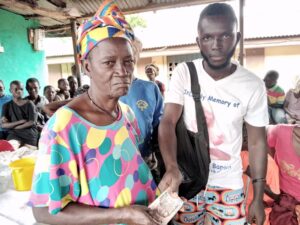
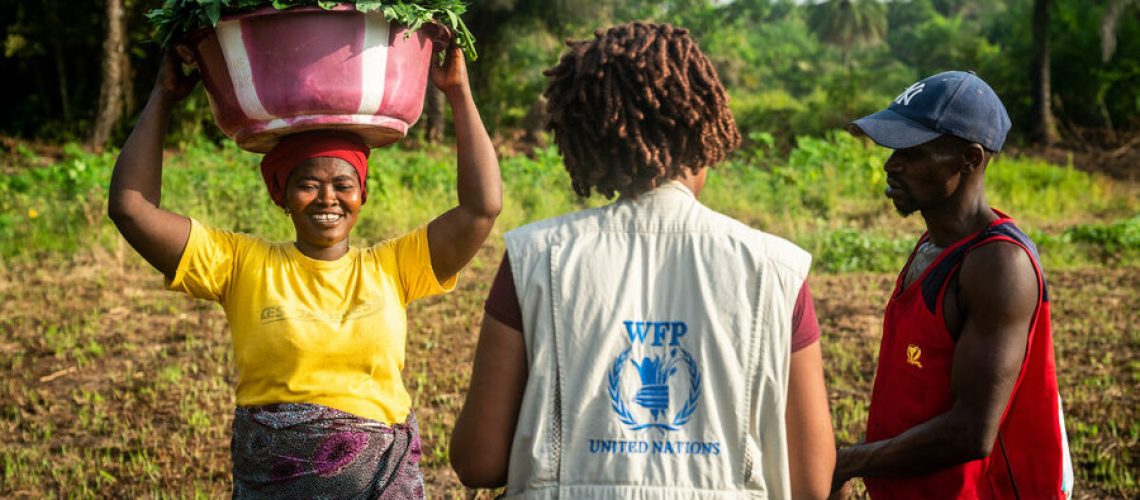
N'yayh Sankoh (left), a smallholder farmer in Tawuya Community, carrying freshly harvested potato leaves speaks to WFP staff.

These farmers are being supported by WFP to cultivate fresh vegetables and legumes for the homegrown school feeding pilot project.

WFP is connecting  the farmers with school feeding programs which purchase fresh produce daily. WFP is also supporting the farmers with seeds as well as training and farming tools.

In its efforts to expand school feeding and extend its potential benefits to more nationals, the Government of Sierra Leone recently launched a policy emphasizing a transition to a better kind of school feeding (home-grown). Collaborating with the Japan International Development Cooperation, the World Food Programme then took a step to implement a pilot that might show the country how to achieve its aspirations, gradually. In the pilot, WFP has connected smallholder farmers to the local schools to supply them with surplus vegetables daily, as well as surplus rice. WFP transfers cash to schools to make these purchases.

Japan has been WFP’s second-largest donor over the past five years, providing consistent food assistance through WFP for nearly US$15 million.

The United Nations World Food Programme (WFP) has welcomed a JPY 200 million (approx. US$ 1.36 million) contribution from the Government of Japan to support 28,800 primary school children in Pujehun district during the 2024-2025 school year.

With this contribution, WFP will provide daily hot and nutritious meals made from Japanese rice along with fresh vegetables that will be locally procured from smallholder farmers.  The assistance will target 137 government-owned and government-supported primary schools across six chiefdoms facing acute food insecurity and prone to climate shocks. 

“The Government of Japan aims for this contribution to help address food insecurity and enhance education in the Pujehun district, aligning with the government’s human capital development efforts through the Free Quality Initiative,” said Hisanobu Mochizuki, Ambassador of Japan to Sierra Leone.

Japan has been WFP’s second-largest donor over the past five years, providing consistent food assistance through WFP for nearly US$15 million.

“This donation confirms the Government of Japan’s commitment to improving educational outcomes in Sierra Leone. It ensures hunger does not stop children from learning and achieving their dreams,” said Yvonne Forsen, Representative and Country Director of WFP Sierra Leone. 

Facebook
Twitter
LinkedIn
Pinterest

Follow Us

Favorite Video

you may like

Trending

img_4346
IMF Approves $248M to Boost Sierra Leone's Economic Stability
Untitled design
Nigerian Billionaire Proposes $5bn Investment in Sierra Leone’s Real Estate, Aviation 
1000w_q95
In Detroit and Freetown, Michigan and Sierra Leone Establish SPP Partnership
Morocco_Mano-River-Union_partnership
Morocco Reaches Out to Mano River Union for Regional Peace & Prosperity